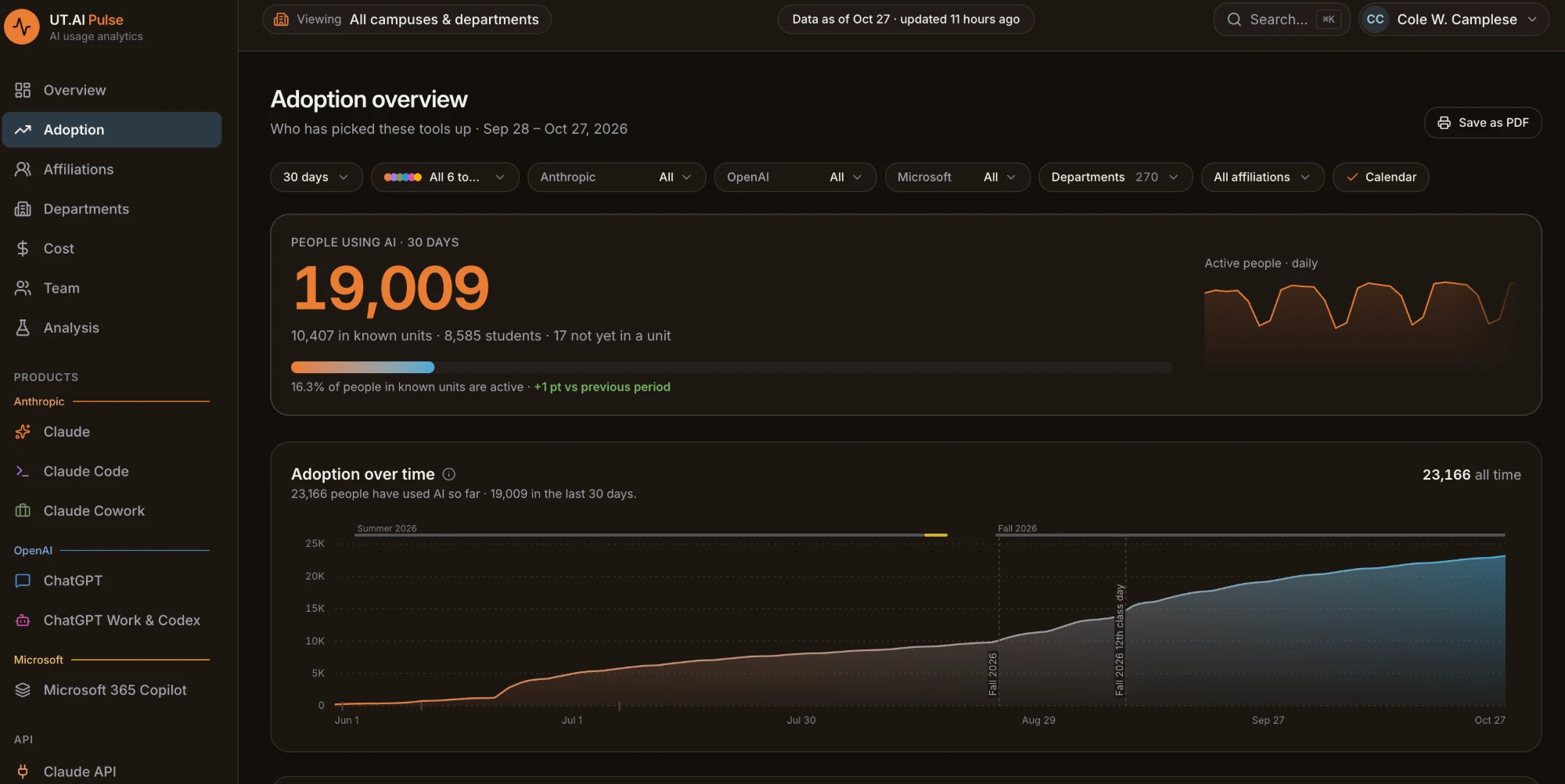
In the last 30 days, 19,009 people at UT Austin used an AI tool, and 23,166 have used one since tracking began this summer. UT.AI Pulse is an internal dashboard built and managed by UT.AI Studio. It gives the team a current, shared view of how AI is being adopted across campus.
Pulse brings usage data from the campus’s AI tools into one place. These are Claude (including Claude Code and Claude Cowork), ChatGPT (including Work & Codex), and Microsoft 365 Copilot. Until now, each vendor reported its own numbers separately.
What Pulse shows
Pulse reports on people, messages, and sessions across campus. It breaks them down by tool, by campus unit, and by affiliation, and it can be filtered by date range and vendor.
What it does not show matters just as much. Pulse counts that people are using these tools, not what they are doing with them. It has no view into prompts, into conversations, or into anything a person types or gets back. The transparency here is about reach and frequency — who has picked these tools up and how often they return to them — and it stops there.
Over the past 30 days, campus recorded about 3.4 million messages and 714,000 sessions. Messages are up 42.2% and sessions are up 51.2% compared with the previous period. Activity is growing faster than the number of users.
Developer use is rising fastest. Claude Code and ChatGPT Work & Codex together generated 37.3 million lines of code, up 64.7%.
Who is using AI
Students make up the largest share of users. About 9,100 students were active, which is 48% of all users and 15% of all students. Staff followed with roughly 8,600 active users (45% of users, 21% of all staff). About 1,300 faculty were active — 7% of users, but 23% of all faculty, the highest rate of take-up of the three groups.
Claude and the two ChatGPT experiences reach the most people. Claude is used by about 12,400 people, ChatGPT Work & Codex by about 10,100, and ChatGPT by about 5,400. Claude Cowork reaches about 2,900 people, Claude Code about 2,300, and Microsoft 365 Copilot about 2,100. Many people use more than one tool.
Where adoption is happening
Adoption varies a lot across campus. Among people in known campus units, 16.3% were active in the period, up one point from the previous period. Some units have more than half of their people using AI, while others are still in the single digits.
That range is what Pulse is meant to help with. Seeing where adoption is strong and where it is just beginning helps UT.AI Studio focus training, support, and tool access where they will make the most difference.
How Pulse protects small groups
Pulse does not rank units with fewer than 15 people, and it does not show units with fewer than five.
“Pulse gives us one place to see how people are really using these tools. That helps us put training and support where they’ll matter most.” — Cody Antunez, Director of AI Infrastructure and Engineering
What’s next
Pulse is an internal tool for now. UT.AI Studio plans to offer high-level views of the data to the audiences they suit best, so that campus leaders and units can see the picture they need without exposing more detail than is appropriate.
Usage is not the same as value, and some of the data lags. Anthropic can be up to four days behind, OpenAI up to three days, and Microsoft reports Copilot over fixed windows. Pulse labels these gaps on the dashboard. As more students, faculty, and staff bring AI into their work, the team will keep using Pulse to guide how it supports them.
Related: Everyone Is Bringing an Agent to Campus: What Democratized AI Means for the Office of the CIO, CIO Perspectives, October 21, 2026.