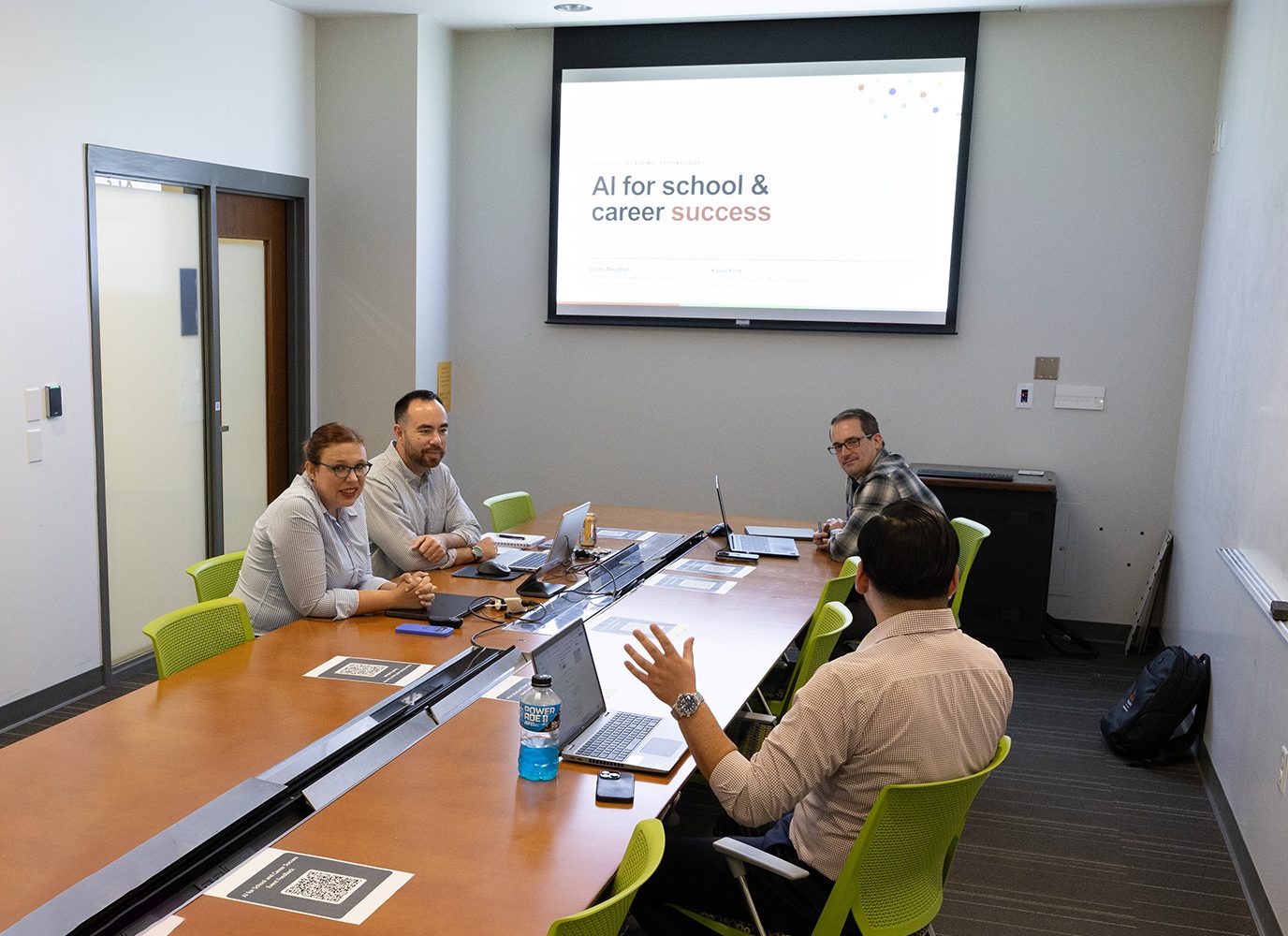
On October 1, veteran and military-affiliated students spent a session working out where artificial intelligence belongs in their own academic and career routines — and where it does not. The hands-on workshop was led by Curtis Maughan of AI Studio and Kasey Ford of the Office of Academic Technology, in collaboration with Texas Veteran and Military Student Experience in the Office of the Registrar.
Start with the work, not the tool
Rather than opening a chat window first, participants started with a task they already knew: updating a resume. They brainstormed and mapped out their own process, then looked at each step and asked which ones they were comfortable handing to AI and which ones they wanted to keep. Only after that did they build reusable skills in Claude and ChatGPT around the steps they had chosen to delegate.
The workshop used the 4D AI Fluency Framework, which organizes the question around delegation, description, discernment, and diligence. Participants applied those four ideas while exploring how AI could help with studying, research, resumes, interview preparation, and translating military experience into the language employers use. Everyone left with a reusable AI skill built for a task they do regularly.
“This session is a great example of a development in how the AI Studio is approaching training. We’re now starting with the workflow, in this case updating a resume, and then integrating AI thoughtfully. Once participants had mapped out their process, they carefully thought about which steps to delegate to their AI tool and which to keep under their control. That decision depends on what is ethical and on what is most effective. By the end of the session, participants were building AI skills in both ChatGPT and Claude, which was really exciting to see.” — Curtis Maughan, AI Studio
Kasey Ford pointed to the larger question the room was working through, one that is not unique to students:
“Students had the same questions about working and learning with AI that we are all struggling with. We all need to have open conversations about where these technologies are helpful and where they are not.” — Kasey Ford, Office of Academic Technology
What it changed in the Registrar’s office
The session also gave the staff who hosted it ideas for their own work. EJ Goodroe, associate registrar for Veteran and Military Support and Certification Services, said his team has since begun exploring how AI could support reporting and catalog update workflows that today require manually compiling information from several different resources.
It changed his thinking as well. Before the session he had concerns about human agency, and about where the line sits between using AI as a tool and letting it replace the work. The workshop’s focus on responsible use — on setting parameters and instructions that preserve a person’s knowledge and voice — shifted his outlook.
The workshop
October 1, 2026. Led by Curtis Maughan (AI Studio) and Kasey Ford (Office of Academic Technology), in collaboration with Texas Veteran and Military Student Experience in the Office of the Registrar. Participants built reusable skills in Claude and ChatGPT using the 4D AI Fluency Framework.
Fluency is a workflow question
The session made the point that building AI fluency is not about learning a particular tool. It is about understanding a workflow, deciding where AI can add value, and using it in ways that keep human judgment and expertise in place.
To our Longhorn veterans: thank you for your service, and for everything you contribute to this campus community.
Where to get help: Claude and ChatGPT are available to the UT community through Claude Edu and OpenAI Edu. AI Studio runs workshops like this one throughout the year — see Training & Learning for what is scheduled.