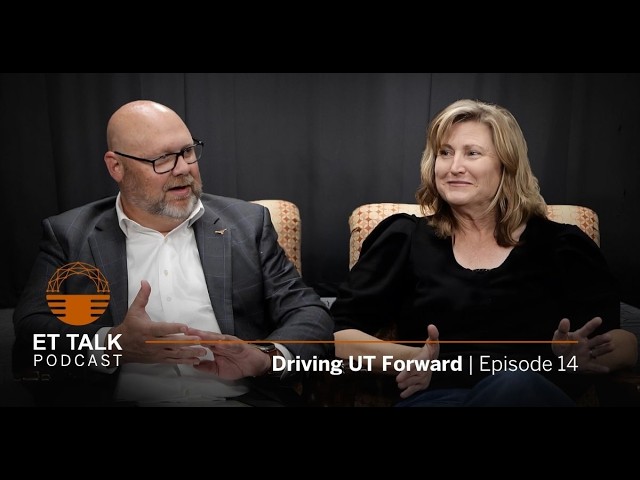
How do you transform IT from a support function into a driver of trust, engagement, and experience? In Episode 14, Cole Camplese sits down with Heather Hanna, Associate Vice President of Engagement and Experience in Enterprise Technology, to talk about the shift toward relationship-driven technology and how Digital ID, service transformation, and AI adoption are reshaping how the University connects with its community.
From UTemp to the bridge between business and technology
Heather marked her 25th anniversary at UT Austin recently. She started as a temporary worker at the IC² Institute, moved to the Office of Accounting, and then into help desk documentation and training for financial information services. A first project to roll out new inventory scanners “failed miserably,” she says, but it hooked her on project work, and her focus shifted from helping people use technology to helping business partners solve problems through it.
That became her through-line. She ran the security component of the Workday implementation, contributed to the benefits implementation, and took a leadership role on UT Works. Her role, she says, was less technical than about helping people understand a new way of working: the bridge between business partners and the technology teams.
Why Enterprise Technology built an Engagement and Experience organization
About 18 months ago, Cole and Heather designed a new organization to put engagement on equal footing with building and running technology. Heather saw it as the first time executive leadership had put real investment behind engagement, a topic campus talks about often. It brings together the Strategic Initiatives Office, a Strategic Relationship Office (project engagement and business relationship management), tier 1 and tier 2 support, endpoint management, and the ServiceNow platform.
Digital ID as a change initiative
Because the service desk is also the campus ID center, Heather serves as program director for Digital ID. She describes it first as a change initiative: it changes the experience for everyone on campus and their relationship to the University. Student experience is the driving factor, and the idea started partly with athletics, where pulling out cards and phones slows entry to large venues. Digital ID was also the first program taken through the Enterprise Technology Executive Committee.
Executive governance and the trust conversation
Heather credits leaders who see the value of technology for making this governance possible. The aim, she says, is not to say where Enterprise Technology thinks the University should go, but to show how technology advances executives’ own priorities. Cole noted that EDUCAUSE’s top IT issues list puts rebuilding trust at the top.
Business relationship management is the next frontier
Heather calls relationship management the most challenging piece, because trust takes consistent success, incremental partnership, and more relationship managers, inside Enterprise Technology as well as across campus. The planned model assigns relationship managers to groups on campus and creates a way to feed what they hear back to the technical teams for roadmaps and work planning. It is not meant to replace existing relationships. Cole said the practice was expected to take two years to stand up and came together in under one.
ServiceNow, reimagined
The team is revamping the service catalog and knowledge base and giving ServiceNow a new look and feel, with consistent standards across campus. Cole compared inconsistent systems to classrooms where one room has light switches and another has a control panel: small barriers that add up for faculty and students. Heather wants answers that can be found through self-help (tier zero), so support staff can focus on harder problems and treat each call as a chance to engage, such as helping a retiree get past Duo.
Starting small with AI
The Strategic Initiatives Office has used Claude, OpenAI, and Copilot for the past three to six months to speed up documents and presentations, leaving project managers more time for problem solving, relationships, and conversation. Cole called it “day zero” for AI adoption in the organization and offered the same advice he gives everyone: start with the smallest task, fix it when it’s wrong, and build from there. He also floated the idea of a “self-healing campus,” where people can build around a broken interface.
The takeaway
Asked what she would tell a technical leader moving into an engagement role, Heather says every framework and practice has to boil down to one question: how are we helping people?