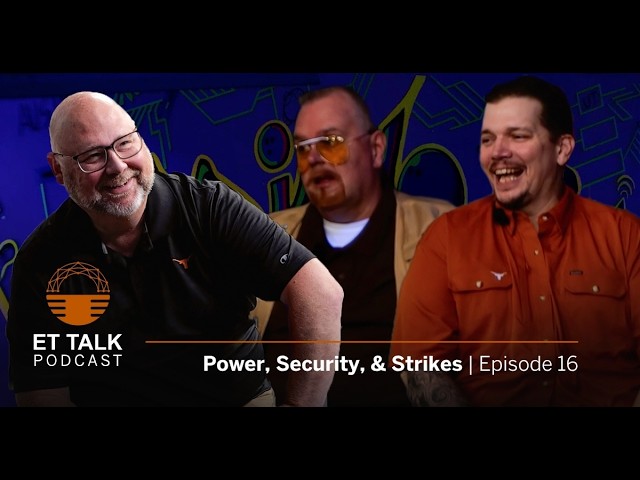
What does it take to keep UT Austin connected, secure, and running smoothly? In Episode 16, Cole Camplese talks with John Lovelace, AVP of Infrastructure, and Mike Martell, Executive Director of Infrastructure, about campus security technology, data centers, AI infrastructure, construction, and football game day. They do it all during a friendly bowling match.
Security technology across campus
Mike’s team runs the electronic safety and security systems on campus, using a platform called Genetec for card readers, surveillance cameras, intrusion detection, and panic alarms. He puts the scale at roughly 2,600 doors and 2,400 cameras and growing. On privacy, he says the approach starts with critical spaces from the Office of Emergency Management’s critical building list, such as power plants and data centers, and then common areas where students transit, working closely with UTPD and the Office of Emergency Management.
A data center built for a different era
The East Campus data center offers about 9,000 square feet of enterprise-class space and hosts equipment for units across campus and for other UT System institutions. Mike says Austin Community College was the first non-UT customer, the city of Georgetown is onboarding, and early talks are under way with the city of Leander. The challenge is power: the facility typically offers 10 to 12 kW per cabinet, while AI clusters are asking for 30 to 40 kW. John notes that a cabinet can be stranded with a single device because it uses all the available power, and that past about 30 kW the conversation moves from air to liquid cooling. A feasibility study with campus operations and Stantec is looking at what power the current facility can offer in the meantime. They also describe the new TACC facility, with cabinets they say reach 240 kW and are cooled on the chip and through the cabinet doors.
The rest of the infrastructure team
Mike’s group also includes the cabling and construction group, an IT warehouse, and a facilities design group that works with planning, design, and construction so that new buildings and remodels meet ET standards. Cole points to how tightly the team works with campus operations as cranes fill the Austin skyline.
Game day
Game day starts well before the weekend: TV trucks begin arriving as early as Tuesday or Wednesday, and the team handles fiber and connections for broadcasts and pop-up shows. Instant replays and medical checks on the field run over ET infrastructure at the stadium. On the security side, the emergency operations center and a game day operations booth watch cameras, and the team tries to bring a report up on camera before UTPD officers arrive. Network colleagues also support athletics operations such as ticketing and vendors.
Paths into technology
Mike started in security technology, and the move into IT was gradual: the security systems themselves have become IP-based, down to the cameras and card reader panels. John came to UT after a leadership program at General Electric. The two say their philosophies of service and running operations like a business line up well.
The final score
The bowling match plays out in the background throughout, and the team says highlights and the final score will be shared separately.