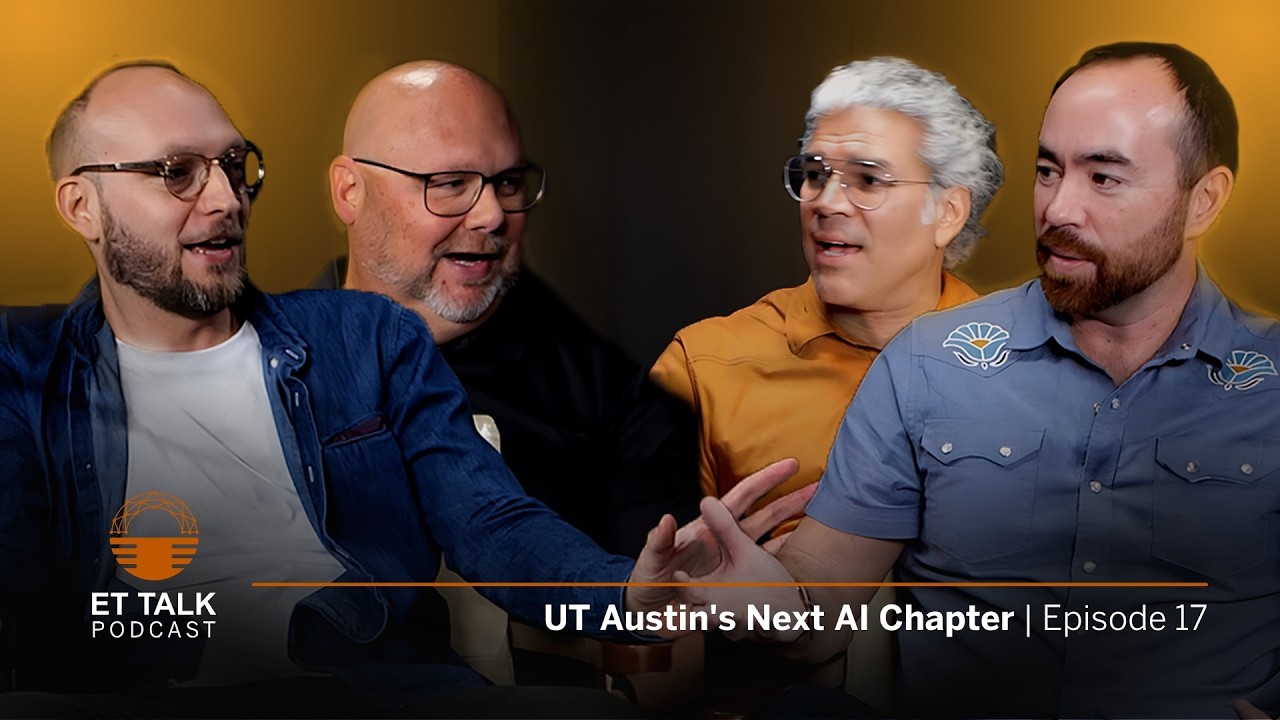
It has been two years since UT Austin’s AI journey began. In Episode 17, Cole Camplese sits down with three members of the AI Studio team: Cody Antunez, Director of Engineering and Innovation; Mario Guerra, Associate Vice President for AI Platforms and Innovation; and Curtis Maughan, Community and Research Lead, who joined the university on July 1. They discuss how UT moved from UT Spark’s multi-model platform to enterprise partnerships with Anthropic and OpenAI, and from a strategy built on access to one built on enablement.
Why UT moved beyond UT Spark
Cody explains that UT Spark gave people access to several model providers, but users overwhelmingly relied on OpenAI and Anthropic models and many also kept personal Claude and ChatGPT accounts. They wanted core features found only in the frontier products. Researchers also needed to name their tools in IRB protocols and asked for assurance that those tools would be around. Mario describes the arc: access through UT Spark in the fall, enterprise license negotiations through the spring, and a June announcement that the licenses were available.
Two tools that complement each other
The team says Claude and ChatGPT work in a complementary way, with adoption running close between them. Curtis says one behavior they want to encourage is comparison: moving between models and seeing how, for example, Codex compares with Claude Code. The licenses also fit different environments, with HIPAA-ready options for health settings and open environments for the rest. Claude and ChatGPT are available to everyone at UT Austin.
Builders and the last-mile problem
With the new tools, people across campus are building real applications. Cody estimates it is now at least hundreds of custom applications a month, far more than last year. The harder problem is what he calls the last mile: apps that need SSO, outside participants, or department-specific requirements, where review and hosting can take weeks. The group sees a campus of full-stack builders whose expertise is context, not coding, such as a procurement specialist who knows exactly what she needs. The AI Studio’s own portal for purchasing additional consumption licenses is an example: it removed hours of manual work, but is now one more service to support.
Community, champions, and showing the work
Curtis says people keep asking for show-and-tell and build-alongs. The AI Champions network, free to join through a short application form, has grown from about 100 to about 175 people, and Curtis thinks it could reach 1,000 by the end of the semester. A build day with the OpenAI team was set for September 23. The team argues that smoothing friction frees time for experimentation, and that staff answering tickets should have perhaps three to five hours a week to experiment. A colleague’s Google Cloud billing task that took about six hours a month, the group says, now takes about a minute.
Talking ideas into existence
The conversation closes on how conversational and voice-driven AI change how people think and work, and on the idea that IT teams have taught how to push a button while the community contributes the why. Cole points listeners to tech.utexas.edu to learn more and to sign up to be an AI Champion.