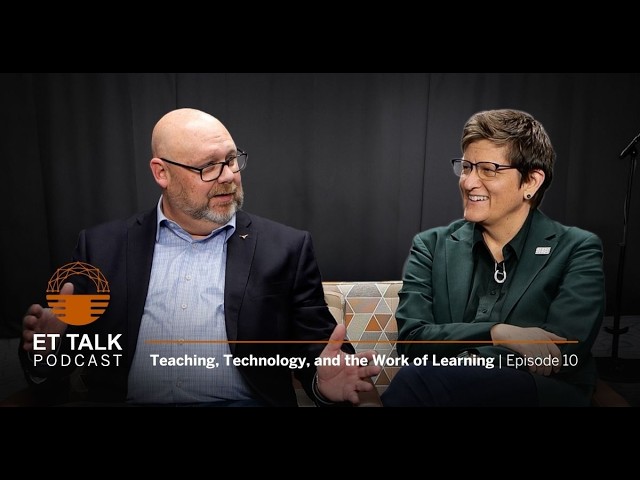
In Episode 10, Cole Camplese is joined by Julie Schell, Assistant Vice Provost of Academic Technology and Director of the Office of Academic Technology, for a special conversation about the work of learning. Their discussion moves from Julie’s origin story with a generous physics professor in Reno, through her research on the effort to improve teaching, to the pedagogical questions raised by AI in the classroom — and into the origin and design of UT Sage, the Claude-powered tutor faculty train themselves inside Canvas.
A teacher who opened the door
Episode 10 is a special one. Cole sits down with Julie Schell — Assistant Vice Provost of Academic Technology and Director of the Office of Academic Technology at UT Austin — for the kind of conversation the series has been building toward since the first foundation-laying weeks. Julie introduces herself simply as the “steward of affective learning with technology,” and the rest of the hour earns that title.
Her own origin story turns on a single relationship. As an undergraduate at the University of Nevada, Reno, Julie was struggling with mechanics. The chair of the physics department — an active researcher — opened his office every day, stood at the chalkboard, and walked her through problem after problem until something clicked. She succeeded in the class. Years later she found her way back to thank him; they still talk today. The conviction she carried out of that office has organized her career: “Anybody can learn anything if the conditions are right.”
From physics to law to learning sciences
Julie’s path to UT runs through an unusual sequence of institutions. After undergrad she did a master’s in educational psychology with a focus on human-computer interaction, helping teachers adopt technology in their classrooms from a cognitive-science point of view. Two years at Stanford followed as a student affairs officer in the legal-clerkship program — an environment that had nothing to do with her prior work, and everything to do with sharpening her question about how people learn complex things.
She then went to Teachers College for a doctorate on a deliberately narrow target: not teaching, but the effort to improve one’s teaching. At an R1 university, where the incentives for that effort are thin, she wanted to understand who undertakes the work anyway and why. The answer she found was a moral impulse — faculty who choose to invest because they want the subject matter to take flight off the page. A postdoc in the Mazur Group at Harvard, working at the intersection of peer instruction and the move from hardware to software clickers, completed the arc that brought her to UT.
Tension and friction as the through line
Julie is a rare combination at a research university. She is a learning scientist and a teacher. She is a leader and a builder. She is a product owner and a policy maker. When Cole asks her how she holds those identities together, she answers without hesitation: tension and friction. Every technology decision puts a constraint on the pedagogy. Every pedagogical decision puts a constraint on the technology. Sitting in that tension is the job.
It is not a new problem. The chalkboard was a technology. So were movie projectors and radios when they arrived in classrooms. Each one disrupted the pedagogy of its moment, and each one became invisible only after teachers found new practices on the other side. Julie’s point is that AI is the latest entry in that long sequence — and the work it asks of teachers is recognizable to anyone who has lived through one of the earlier shifts.
Seeing learning, not just performance
One of the most useful distinctions in the episode is between what technology lets us measure and what it lets us see. Performance is easy to measure. Learning is much harder. Julie traces this back to her work in the Mazur Group, where peer instruction depended on a simple move — turn to your neighbor and try to convince them of your answer — and software-based clickers made it possible to track which students were natural teachers, the ones who could reliably bring a peer with the wrong answer to the right one. That was not a performance signal. It was a learning signal.
She returns to that distinction throughout the conversation. The reason she is optimistic about this AI moment is not that it will produce better scores. It is that, done well, it might give teachers a way to actually see learning happen — the metacognition, the self-regulation, the self-efficacy — instead of inferring it from outputs.
The teacher’s new task: reading learning
Julie teaches a course called Design Pedagogy, in which students are themselves learning to teach. One assignment asks them to design a 3D object and pitch it with a short video that explains a topic they once found hard. Julie is AI-forward by policy in her class, and last semester she watched students offload the creation of the pitch video to AI. Nothing in her policy barred it — but when she read the output, she could not see her students in it. She could not see the learning.
Her response is not to retreat. She names a tempting nostalgia she sees in colleagues — for oral exams, blue books, the old recitations — and gently sets it aside. The skill shift, she argues, is forward, not back. Borrowing a framing from a Berkeley paper, she organizes the new teacher’s task in three moves: recognize when an AI use will create a skill deficit, articulate that to the student, and then teach students to use AI for task augmentation instead. The Pythagorean-theorem example lands the distinction. “Do my homework problems” is a skill deficit. “Generate ten harder versions, point out the underlying structure I am missing, and don’t give me the answers” is augmentation. If we can teach students to make that move, she says, we are on to something genuinely new.
Cole notes how directly that framing maps to his own world. The job of a coder, increasingly, is to read and correct code with foundational expertise, not to type every line themselves. Julie’s job description for the teacher is the same shape: learn to read learning in new ways, and learn to discern when it is actually happening.
- Skill deficit — AI use that quietly atrophies the capability the assignment was meant to build
- Task augmentation — AI use that extends a student’s effort with feedback, harder problems, and a partner that scaffolds toward the answer without giving it
- The teacher’s new craft — learning to read learning, not just grade outputs
Student-centered teaching, student-centered AI
Julie pushes on a quiet bias in the current generation of AI tools. The models, by default, tend to operate in a teacher-centered mode — what is the topic, what is the content, what is the assessment — because that is how most of their training data describes teaching. Student-centered teaching starts from a different question: who is the learner, what do they already know, what do they need to be able to do? When Julie tried to build a tutoring lesson on tokens and context windows inside a general model, the learning outcomes were well written, but the content drifted off them, and the assessment was not tagged back to either. The friction was real.
Cole’s response is to think out loud about shareable skills as a path to scale. The strongest instructional designers on campus do not need to clone themselves; they need to make the moves they already know how to do portable, so a faculty member’s environment can call on them. “Not everybody needs to be an instructional designer,” Cole says, “because the top instructional designers on this campus could, in effect, define almost like a choose-your-own-adventure storybook that could load those skills into a faculty member’s environment.” That is how instructional design starts to scale across a 15,000-faculty university.
UT Sage’s origin story
Most peer institutions are watching UT’s experiment in this space. They expected campuses to buy a Johnny-come-lately tutor off the shelf. UT built one. Cole asks Julie for the origin story, and she tells it precisely. November 2023. OpenAI had just released custom GPTs, and Julie was up late prototyping. She picked the hardest small problem she could think of from her own teaching — learning outcomes are difficult to write well — and built a custom GPT to teach them. Fifteen minutes later, when she watched the output as a student would experience it, she shot back from her desk and messaged her boss: “I built this. This is incredible. I think this is a really important moment.” That was the birth of Sage.
Today UT Sage is a Claude-powered platform that students reach not as a separate tool but as a link from inside Canvas — inside the learning space their faculty member has already built. The relative advantage students name when researchers ask is specific: their professor trained the tutor. Sage is built at the lesson or topic level rather than the whole course, for two reasons. The pedagogical one — it lowers the threshold to get started, one concept at a time. The practical one — tokens are not free, and a tighter context produces a better tutor. The faculty side asks teachers to surface the pedagogical content knowledge they usually never write down: the common misconceptions, the moves that work, the places students reliably get stuck.
What students get on the other side is the combined expertise of the general model and the human expertise of their particular faculty member. That second layer is not in the model and never will be. It is the intuition Sage was designed to make visible.
- Built, not bought — a Claude-powered tutor faculty train themselves
- Inside Canvas — students reach Sage from the learning space their faculty already created
- Lesson-level scope — pedagogically lower-threshold and operationally token-efficient
- Faculty pedagogical content knowledge — surfaced, written down, and made available to every student in the course
Learning is the making of memories
One of Julie’s favorite Sage stories is not about Sage working. It is about Sage breaking. A student in a research-methods class hit a problem the tutor couldn’t solve, spent a couple of hours debugging it, identified the attribution error, and asked his faculty member to pass the fix along to the development team. That is not performance, Julie says. That is metacognition, self-regulation, and self-efficacy in plain sight — exactly the kind of learning the field has not figured out how to measure at scale.
Her pitch from there is a real one. Universities are about to deploy AI platforms in mass. There is an opportunity, while the floor is still wet, to build a learning index into them — something that reflects back to both teacher and student how the work was done, not just whether it was right. Cole picks up the thread with his own example: an agent he has named Carl who tracks his work at UT and is quietly writing his biography from the inside. Julie’s framing is the one that lands the episode. “All learning,” she says, “is the making of memories.”
Her closing advice to faculty is the same advice that produced Sage in the first place. Find a teaching problem you actually have. Pick something you have always struggled to teach well. Give one of the models some context, and ask it to think along with you. That is how a new pedagogy gets built — one teaching problem, one collaboration with the machine, one made memory at a time.