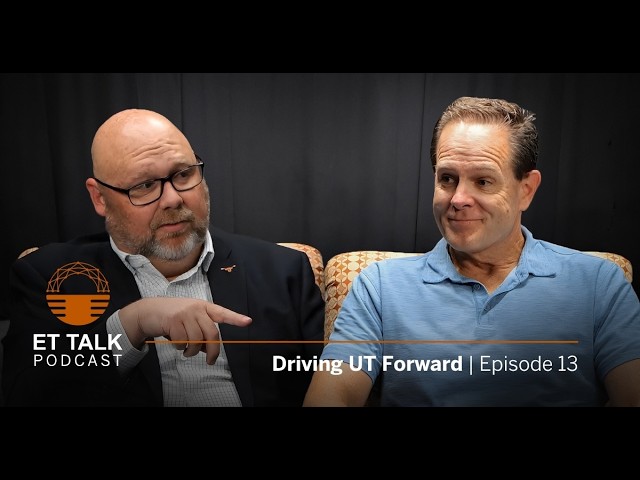
What does AI adoption look like for the faculty we spent two decades coaxing onto a learning management system? In Episode 13, Cole Camplese sits down with Matt Meyer — ET’s new AVP for Enterprise Initiatives & Instructional Technology — just weeks after Matt’s arrival and a major Canvas incident. They trace the line from the edtech boom and the pandemic’s forced adoption to a campus that is days away from putting OpenAI and Claude in every hand, argue that AI is collapsing the instructional design process down to minutes, make the case that faculty will adopt by ‘asking the data’ rather than learning a tool, and reframe the LMS as first-class enterprise infrastructure instead of a boutique app.
Coming home to academic technology
Episode 13 turns the lens inward. After several episodes spent talking to leaders outside Enterprise Technology — looking for the overlaps that connect the university’s work — Cole Camplese sits down with someone new to UT but not new to him: Matt Meyer, ET’s Associate Vice President for Enterprise Initiatives & Instructional Technology, and a friend and colleague Cole has worked with before. Matt is counting his tenure in days, with a running joke that twenty-three of them somehow equal one month from his start date.
The role itself is built for the big, hard problems — services that need to be re-engineered, sometimes moved across campus and sometimes rebuilt in place. But the other half of the job lands Matt back in the instructional design and instructional technology world where both he and Cole cut their teeth. He had stepped away for a stretch — most recently spending two and a half years as a deputy CIO, deliberately broadening across the full IT portfolio to, as he puts it, finally learn the difference between a switch and a router. Coming back after roughly four years away, he finds a field in upheaval — and says that’s exactly what makes it exciting again, rather than business-as-usual.
From the edtech boom to the pandemic’s forced adoption
Cole and Matt both lived through the mid-2000s edtech boom — when venture capital poured into the marketplace, web 2.0 arrived, and learning management systems and lecture capture rose to prominence. What strikes them is that those tools all still exist today. The thing that finally changed adoption wasn’t a feature; it was the pandemic. The forced wave of 2020 brought a generation of faculty into the tools and left many of them not reliant on the technology but genuinely comfortable with it. The LMS stopped sitting on the edge and simply became part of the toolkit.
Matt led the Blackboard-to-Canvas migration at the University of Chicago, where faculty adoption was very low until that crazy day in March 2020. Chicago’s traditional, chalkboard, sage-on-the-stage culture made it a tough sell, and roughly 2,000 faculty had no experience teaching online at all. Cole, then at Northeastern, pivoted the institution from Blackboard to Canvas in about a month. What got them through, Matt says, was a lesson universities shared freely with each other that spring: don’t bundle the software tools — bundle the instructional design. ‘We’re not teaching you three different tools,’ the message became. ‘We’re teaching you a workflow, an ecosystem — and these tools are part of it.’ That reframing is what kept the teaching mission alive after the three-week break that March.
The next adoption curve is AI
Now they’re watching another revolution — one that takes Cole all the way back to the first war he fought on Penn State’s campus, getting even one percent of the faculty to adopt a web-based learning system. The university is only weeks from putting OpenAI and Claude in the hands of every faculty, staff, and student member. So what does that adoption curve look like next to the learning technologies they spent decades coaxing into faculty hands?
Matt’s answer is the same playbook: package it as part of the workflow. The early adopters will show up to training because they want to — but the real audience is the quiet middle, and you don’t reach them by explaining how the tool operates. You start from a problem the person actually has, or even something they don’t yet think is a problem but could be automated away. It’s the old instructional-design move: find the one spot where practice is flawed or outcomes aren’t what you want, and run an intervention right there. Don’t try to change the whole thing — pick your spot, and make a difference in the place you can wrap your head around.
When AI collapses the instructional design process
Matt’s own onboarding became the proof of concept. Inside his first month he stopped treating Claude as something he’d tried before and started really using it — feeding it bullet points and whatever was in his head to draft a strategy, then watching it come back, recognize his intent, and start a conversation back at him. In two weeks he had produced five strategy documents he calls world-class. The artifacts, he says, blew him away.
That experience quietly dismantles the old methodology. The classic instructional design discipline — the Dick & Carey model — said you didn’t even choose your technology until you understood the instructional problem. Software development carried the same logic for good reason: nail the requirements, agree on the wireframes, because changes downstream are expensive. A single forgotten requirement used to trigger days of change-order back-and-forth — back to the designers, over to the engineers, into a test plan. Now, Matt says, it’s minutes. And the economics are staggering: the field used to measure roughly 200 hours of design for a single hour of delivered instruction — 250 for something better, about 170 bare-bones, and even Penn State’s World Campus targeted around 100 hours per instructional hour against a 15-hour class. An instructor could now walk up to a chatbot, say ‘be an instructional designer for me,’ and go straight from their head to Canvas or a worksheet. At a heavily residential campus like UT, which has never had a deep bench of instructional designers, that’s genuinely unexplored territory.
Asking the data
Whether AI nudges faculty toward more structured learning design, Matt says, is a jury that’s still out. Faculty aren’t required to have professional development in the art of teaching, and most already have a structure they like. The more promising opening is on what he calls the back end — the interface where teaching is actually happening in real time. Faculty are data people; they understand asking questions of data. So rather than learning a tool, they could simply ask one: What was the most-missed question on that quiz? Was it poorly written, or did I not teach it well? That, Cole notes, is instructional design happening in real time — designing backwards toward the next challenge — and it replaces the mental data-mining designers used to do by hand, combing through logs and test scores.
Here the conversation lands on infrastructure UT already has. As a member of the Unizin consortium, the university has access to the Unizin Data Platform, which captures essentially every clickstream the LMS produces — time on task, time on page, logins, whether a student watched a video all the way through, whether an assignment was really submitted. Expose that as a data layer behind a faculty-facing AI skill or agent, and an instructor could ask about just their own sections — even compare anonymously against similar courses. Push it one layer further, to the agent layer, and the report delivers itself: faculty who opt in get a daily rundown of their class’s performance with two or three strategies to try. Ask ‘who are my five least-engaged students?’ and the back-and-forth quickly becomes a teaching strategy — even if, as Cole jokes, the answer turns out to be that those five just sit in the back of the room.
- The Unizin Data Platform already holds the clickstream — time on task, video completion, logins, submissions
- A faculty-facing agent could answer questions about just your sections, even comparing anonymously to similar courses
- The agent layer: an opt-in daily rundown with two or three strategies to try
AI makes us sharper, not dumber
The point isn’t more dashboards. Higher-ed dashboards have always lived at the intersection of usable data and gettable data — ‘good enough’ dashboards, baked by developers in Power BI and Tableau and largely inflexible once shipped. Matt contrasts that with watching Claude Code pull data into a preview pane in real time: you see something unexpected, it sparks a better question, and the nonstop iteration is the whole value. The human, he argues, is the third element — the lens. He and Cole could run the very same exercise and, because of their different interests, branch into entirely different streams of questions.
Both push hard on the narrative that AI is making people dumber. Their lived experience is the opposite: they learn more in a session than they feel they give it, because the output fills the gaps with the collective knowledge of humankind. Twenty or thirty minutes of working a problem leaves Matt more well-rounded and walking around with new frameworks for how to approach the next one. And the real payoff, they agree, is redirecting the calories we burn — the token burn — toward the human element: the relationships that are the actual work.
May 5th, and the LMS as a first-class system
Speaking of burning calories — on May 5th, just after Matt arrived, ET had its first major incident with Canvas. It was Matt’s baptism by fire. Finals were over, but there were uncommitted grades and a lot of unknowns, and for the first twenty-four hours he was half-convinced he was being punked — that ET breaks every new AVP’s primary system on arrival. Nobody wants to walk into that. But what Matt saw with outside eyes was how the campus responded, and he brought process ideas from Tarleton, Northeastern, Chicago, and Penn State that UT simply didn’t have yet — an unorthodox but genuinely useful way to onboard.
The deeper realization came in a compliance committee meeting with the president and provost: the LMS is not a boutique application anymore. It’s the face of teaching and learning to the world — the one piece of technology every faculty member and every student touches every single day — and yet most institutions resource it as a second-class citizen behind their people, finance, and student systems. The conclusion was that it needs to move onto the ERP team and be run like one. ET also met with the CEO of Instructure, who is personally on Zoom with CIOs across the country; as the vendor talked about getting better, ET was cycling through how it needs to get better too. The business-continuity stakes are concrete: an outage mid-semester is a problem, but during finals it can stop students from graduating, getting transcripts, or receiving aid. ‘It’s up all the time’ isn’t a measure of value — it’s the floor.
- The LMS is the only technology every faculty member and student uses every day
- Most institutions still resource it behind HR, finance, and student systems
- Move it onto the ERP team — and build real business continuity for finals week
Rethinking software as a service — and investing in people
All of it forces a rethink of ‘software as a service.’ To a lot of people, Matt says, SaaS means someone else does everything — but just because a system runs in the cloud under a vendor, there’s still an enormous amount of work on this side of the fence, and it’s time to put a value on that and build the resilience to bring the service back at the snap of a finger. The pandemic was the opposite problem: tools without adoption. Now UT has the adoption but the tools failed, and that inversion is making the institution reevaluate everything.
Notably, neither of them thinks the LMS is an application at risk. It’s more adopted than it’s ever been and still inside its adoption cycle — the next move is helping faculty extend it. A faculty member who dips a toe on the analytics back end might discover they can build an interactive activity that lets students manipulate an atom’s structure for themselves. The way to drive that, Matt argues, is to recognize the community of practice of faculty who relish teaching with technology, find them intentionally, and elevate them on a stage. Tools don’t drive adoption — faculty are high-end professionals whose time is more valuable than the effort until they see a peer in their own field do something successful. And the economics cut an interesting way: the more you use AI the more expensive it gets, but the more you use Canvas the more reasonable it becomes, because it was purpose-built by learning scientists to help students learn. Every investment is ultimately a choice, and both land in the same place — people are what make the difference.
Thirty days on the 40 Acres
Cole closes with the question he asks every new arrival: what’s surprised you most? Matt’s answer is two-fold. First, the scale — how a place this big does so much with so little, running the entire LMS and its support with lean, still-forming teams in the middle of a transition that hasn’t yet had the chance to step back and ask what it actually needs. He’s worked at smaller universities with comparable resources for narrower jobs, and finds UT’s output incredible.
Second, the energy. It’s off the charts, Matt says — the first place he’s worked where everyone he meets carries a deep, genuine, positive passion for the institution, even amid the normal frustrations of any job. That energy is what brings him to the office. Thirty days in, his verdict is simple: hook ’em. Cole signs off promising the first of many visits.