
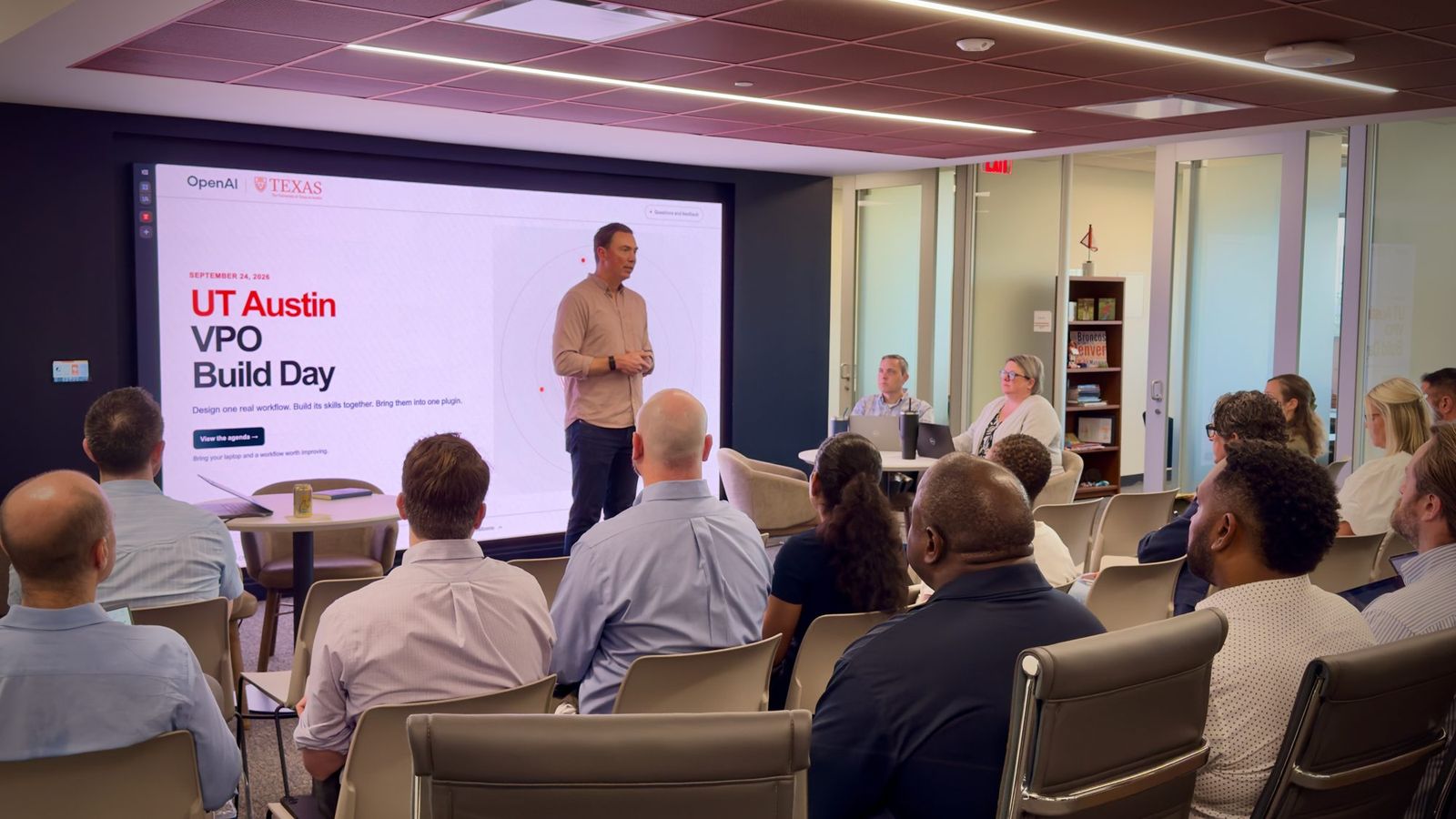
In July I wrote about a retreat the Enterprise Technology senior leadership team had to focus on our AI journey within the organization. After lots of discussion we decided that the best way to grow AI adoption outside of ET is to first grow inside ET. That was easy to write. The harder part came next: every member of the senior leadership team walked out of our retreat with a written commitment and an October 1 deadline. Not a strategy, not a roadmap. A commitment, in their own words, that their part of ET would be different by a date certain.
October 1 has come and gone. Mario reminded us and opened the thread in the SLT Teams channel and asked everyone to post. What follows is my read on what came back.
The commitments that landed best were not the ones with the biggest ambition. They were the ones where somebody did the work and then told us honestly what the work taught them. Two of them changed shape partway through.
What each team committed, and where it landed
AI Platforms and Innovation
Mario Guerra committed to launching a registry of use cases, tools, and skills for every ET staff member, and to activating AI Champions in every column of ET. His team has a working prototype of the registry, built on TexStack, a catalog of AI skills, tools, and workflows built by UT Austin faculty, staff, and students. Find one, see it work, use it. He put it in front of the SLT first and asked for feedback before asking anyone to adopt it, which is the right order. This will be become our first real registry.
Infrastructure
John Lovelace reported both of his commitments complete. On deploying on-premise AI hardware, his team finished an initial buildout of cabinets for equipment coming in from the AI Studio and the Information Security Office, commissioned a study that produced options and estimates within the existing facility, and opened discussions with University Operations about building capacity elsewhere on campus. The honest footnote is that additional buildout requires capital investment, and that conversation is now in front of us rather than hypothetical.
On documenting the first campus network AI agent, agents are deployed and working within the wide area network team today. The campus network team has identified and is prioritizing a set of agentic use cases and has begun development on a network troubleshooting agent. This is the quietest commitment on the list and one of the most consequential. If an agent can shorten the path from a network symptom to a cause, that time comes back to campus, not to us.
Enterprise Platforms
Graham Chapman’s team built two guilds that people chose to join. The EP AI Guild is for developers, and it is where engineers show each other what they are actually trying. The ET AI Users Group does the same work for non-developers across all of ET; 19 people came to its first meeting. Underneath both, the practical barriers are cleared: the people who need admin accounts have them, and licenses are being provisioned to the people who need them.
The most interesting early work is on DEFINE’s Natural mainframe code. One of Graham’s engineers has been indexing the DEFINE codebase with abstract syntax trees, which in his tests cut the cost of loading the whole codebase into a model from more than 88 million tokens to about 5 million, with most questions costing around 500 tokens. Another is testing Bedrock against the same kind of code. Both are early evaluations and no real work runs through either one yet. I am saying that plainly because it matters: if the approach holds up, asking a model about DEFINE’s code becomes practical, and that is a genuinely different relationship with a system we have been managing for decades.
Graham also reported the most useful failure of the quarter. Once his engineers spent real time in the tools, the prompt-and-pattern library they had committed to turned out to be the wrong shape. What people needed was not a library of prompts but a skill, a packaged way of doing one specific task, and a way to share those skills across teams. His team built a basic skill-sharing tool, then stopped and chose to build with the AI Studio on TexStack rather than alongside it. Changing your answer because the work told you to is exactly what I hoped Day Zero would produce. Stopping your own tool so it does not compete with a colleague’s is better than that.
Engagement & Experience
Heather Hanna delivered. Six AI Champions now represent all three E&E teams in ET Build activities, and the E&E AI Hub is established as the division’s home for AI collaboration. With the champions named and the Hub online, the team launched internal focus groups to mature its AI footprint in EPM platform support, ServiceNow, project management practices, Support Center analytics, and Tier 0 support.
The proof point is in ServiceNow Knowledge Management, where the team used Claude to analyze 46 knowledge bases, roughly 7,300 articles with about 5,000 in scope for remediation, and identified the attributes that justify retiring an article outright instead of reviewing all 5,000 one at a time. They are now using AI to help consolidate and templatize the articles in the five largest knowledge bases, so campus gets a consistent experience regardless of which service it needs. Together those steps cut clean-up time by at least half. That is the pattern I want more of: use the tool to decide what work does not need doing, then do the rest better.
Campus Solutions
Dave Moss committed to an Accelerated Application Deployment Pipeline by October 1, and Campus Solutions launched it. UT.AI Forge is live at its own domain, forge.utexas.edu, with a waitlist for users who want in. The trial takes up to ten early adopters and five have signed on, each getting hands-on help from the Forge team with support through the end of the year. The goal is for three to five of them to be in general availability by the time the trial wraps.
What I like about this update is that it is written like a pilot and not like a launch. The ISO review is pending and the team said so. Dashboards are being built and the team is asking participants which metrics are worth showing rather than guessing. The support model is being refined so that what is learned from the first five shapes how everyone after them is helped.
Enterprise Initiatives & Instructional Technology
Matt Meyer committed to moving Enterprise Learning Technology and the Digital Accessibility Center to active fluency across Claude and ChatGPT, with two agents deployed in production. He reported it partially complete, which I appreciate. Fluency is done: both teams completed training and both now use the platforms frequently in their regular work. The agents are in beta with production targeted for late November.
The agents are worth describing, because they started with a faculty problem rather than a technology. The Digital Accessibility Center and the AI Studio are building two of them, packaged as a platform called ClearDay, and the work came directly from faculty feedback, particularly in STEM, where handwritten lecture notes are hard to make accessible. One agent converts handwritten lecture notes and assignments into accessible formats, and it was developed with an AI Studio PhD candidate. The other converts the PDF articles that are used constantly in courses. Each produces accessible HTML, a simplified PDF with decorative elements removed, and a format-preserving PDF with improved accessibility. The platform has single sign-on, is in beta user testing, and is going through ISO approval.
In July I wrote that when the UT.AI Studio fully launched we would be able to augment our teams with AI Student Builders. That was a forecast. A graduate student helping build an agent that will put accessible course materials in front of students this spring is the thing itself, arriving earlier and more quietly than I expected. Our first full student cohort will be arriving in Spring.
Operations
Amanda Fratticcioli’s team built the ET Travel Guidelines Assistant, which helps ET employees navigate travel from authorization through reimbursement. It explains when an RTA is required, gives the correct ET routing, answers booking and expense questions, identifies documentation and deadlines, and checks current UT guidance when rates or requirements may have changed. For unusual, international, grant-funded, or mixed personal and business itineraries, it flags the problem early and sends the traveler to ET Operations instead of guessing.
It is already in real use. Staff planning travel to ET Build Day have had it surface a flight time and set an Outlook reminder to file the reimbursement seven days after the trip ends. That is a small thing. It is also the kind of small thing that, multiplied across an organization of our size, is worth a great deal of recovered attention. The team has spent its time testing for accuracy and keeping the assistant inside ET travel policy rather than letting it answer questions it has no business answering. Travel is the sort of process everyone complains about and nobody owns fixing. This team owned it.
What I take from this
Nearly all of it delivered, and the one report of partial completion was more useful to me than a green checkmark would have been. But the scorecard is not the interesting part.
The interesting part is that the organization started telling itself the truth. Two teams changed course because the work pushed them in directions they didn’t expect. One leader reported partial completion when a less careful one would have reported done. Several teams stopped building things once they found a colleague building the same thing better. We have spent years as an organization that is very good at delivering for campus and not especially good at examining its own practice. The commitments were a forcing function for the second thing, and it is working.
The gap I see is distribution. Nearly all of this lives inside the teams that built it. The guilds are real but they are opt-in. The registry is a prototype in front of the SLT. The agents are in beta. The skills exist but the shelf to put them on is still being built. The next turn is from building to spreading, and that is what the ET team is really good at.
So here is the next commitment, and it is mine. We said the only way to grow outside of ET is to first grow inside ET. We have now done enough inside to test the second half of that sentence. In the coming months I want every one of these to have left the team that made it: the registry open to all of ET, ClearDay in production, the network agent documented, Forge graduating its first cohort into general availability, the knowledge base work turned into a method that keeps us current, and the travel assistant answering questions for people who never had to ask for it. Day Zero was about starting. This next stretch is about whether any of it sticks.


Leave a Reply